
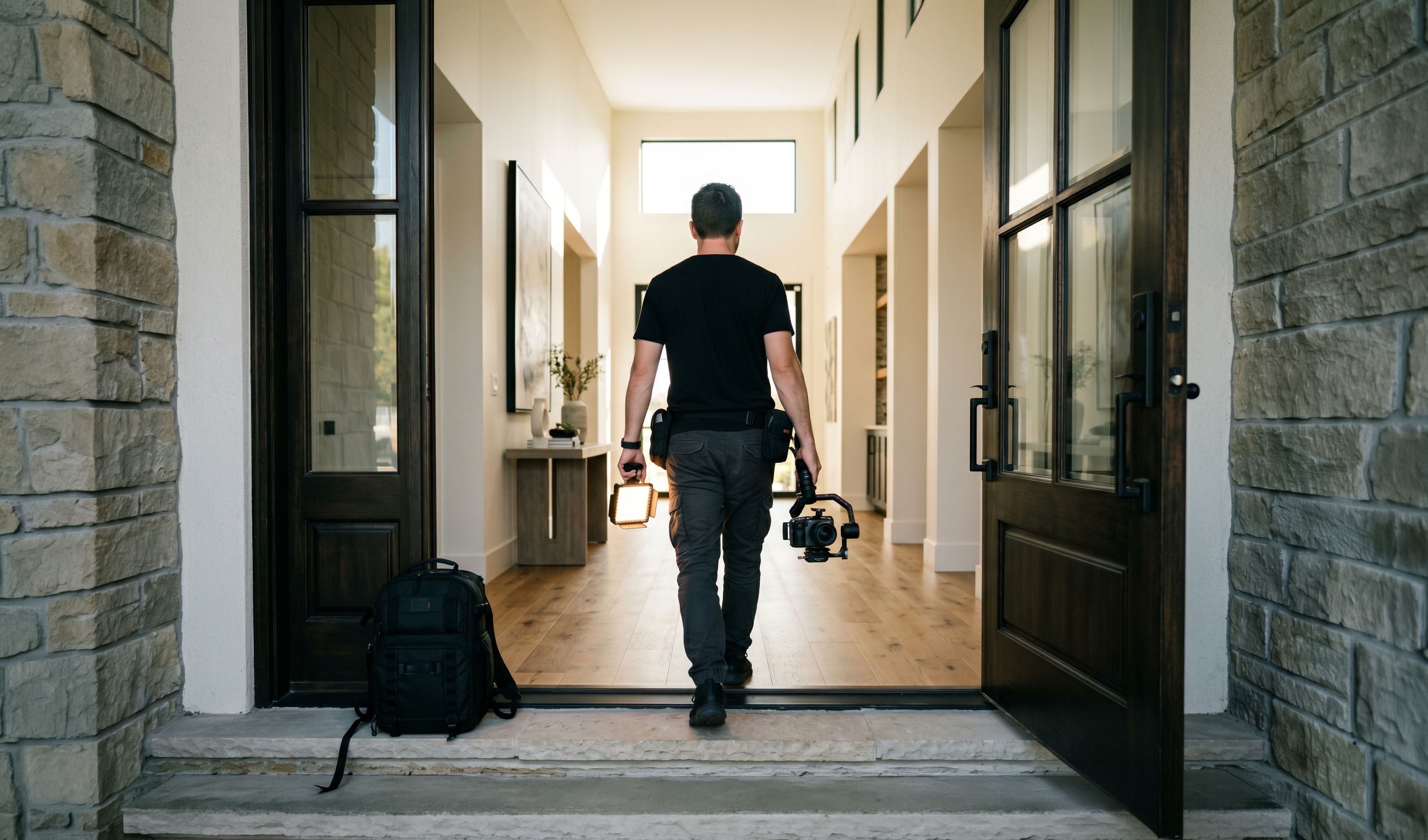
Real Estate Videographer: What to Expect and How to Choose
Property video is no longer a premium add-on reserved for eight-figure estates. It's the first impression most buyers get, and it shapes whether they book a showing or scroll past entirely. A professional real estate videographer does far more than walk through a property with a camera, they plan, direct, and edit a marketing asset designed to move buyers emotionally before they ever step foot inside.
This guide gives you a complete picture of what the role actually involves, what packages should include, how pricing works across different tiers, what separates a polished portfolio from an average one, and the questions that protect your investment before you sign anything. The highest-performing property campaigns treat video as a full creative production. 101 Studios builds every shoot around a clear strategic objective, which is exactly the benchmark you should hold any videographer to.
What a real estate videographer is actually responsible for
The most common misconception about property videography is that the job begins and ends on shoot day. In reality, the work spans three distinct phases, and the quality of each one determines whether the final video feels intentional or improvised. Understanding this scope helps you evaluate whether a videographer is genuinely professional or simply someone with decent gear.
Pre-shoot planning and creative direction
Before a camera leaves the bag, a professional real estate videographer works through a detailed brief. That means reviewing floor plans, identifying the property's key selling features, building a shot list, and scouting for lighting conditions at the right time of day. This planning phase is what separates a structured, story-driven video from footage that jumps randomly between rooms with no clear editorial logic.
For luxury or developer projects, pre-production also includes confirming talent logistics, voiceover scripts, and creative direction alignment with the agent or marketing team. The more thorough this phase, the less reactive everything becomes on location.
On-location production: equipment and technique
Professional production relies on cinema or full-frame mirrorless cameras, such as the Sony FX3 or A7S III, gimbals for fluid walkthrough movement through tight hallways and staircases, drone rigs for aerial context and scale, and controlled lighting setups for challenging interiors. These are not aesthetic preferences; they directly determine dynamic range, stabilisation, and the visual coherence between indoor and outdoor footage.
Technique matters as much as equipment. Focal length selection, movement speed, and subject framing all influence whether a viewer feels drawn into the space or simply observing it. A wide establishing shot that opens a sequence creates narrative context. A slow gimbal pull-through a hallway builds anticipation. These decisions are what distinguish a cinematically directed video from an amateur walk-and-shoot.
Post-production and the delivery pipeline
After the shoot, the work continues in the edit suite. Footage selection, color grading with custom LUTs, music licensing, motion graphics, branded lower-thirds, and social-format vertical cuts are all part of a professional post-production workflow. Turnaround times typically run between 48 hours and one week depending on package scope, with rush delivery available at a premium. Final files are usually delivered via a shared gallery or agent dashboard, ready for MLS upload, property websites, and social platforms.
What a professional real estate video package should include
Agents and sellers often accept the first package they're quoted without knowing whether it's comprehensive or stripped back to the bare minimum. Having a clear benchmark lets you compare offers on total deliverable value rather than headline price alone.
Core deliverables across standard tiers
A basic package delivers a 60, 90 second walkthrough with straightforward editing and licensed music. A mid-tier package typically includes a 2, 3 minute cinematic video, exterior drone footage, color grading, and a vertical social cut. Premium tiers add voiceover narration, agent interview segments, community B-roll, virtual tour integration, and branded lower-thirds throughout. Full commercial usage rights for MLS, websites, and social platforms should be included as standard at every tier, not treated as an upgrade.
Add-ons that genuinely move the needle
Not all upgrades justify their cost equally. Vertical social media cuts are consistently worth the investment because short-form vertical content generates significantly more engagement than landscape-only delivery on platforms like Instagram and TikTok. Drone aerials provide the contextual storytelling that ground-level footage simply cannot, particularly for properties with strong land, views, or neighbourhood positioning. Narrated voiceover is worth adding for luxury and developer listings where buyers need guided context, not just visual impressions.
Some studios bundle these elements automatically within their core packages, while others charge separately for each. Comparing total package value is always more useful than comparing the entry-level price point, because the final cost often looks quite different once variables are applied.
How real estate videography is priced
Pricing for property video varies more than most clients expect, not just between cities but between providers operating in the same suburb. Understanding the logic behind pricing models makes it easier to identify genuine value versus an inflated quote or a suspiciously low one that will disappoint on delivery.
Standard pricing tiers and what they reflect
Three pricing models are common across the industry: flat fee by property size, tiered packages by deliverable scope, and hourly rates for smaller or add-on shoots. Based on typical market rates, basic walkthrough packages run from , , standard cinematic packages from , , and premium narrated campaigns from , or more. Specialist work like FPV drone videography or large developer campaigns ranges from to ,000 and above. Urban markets consistently sit at the higher end of those ranges, with cities like Sydney reflecting significantly higher production costs than rural or suburban areas.
What drives the cost beyond the base rate
Properties over 5,000 square feet often carry a size premium due to the extended shoot and editing time required. Challenging interiors with multiple levels, large outdoor areas, or difficult natural light conditions add production complexity. Rush turnaround fees apply when delivery is needed within 24, 48 hours. Add-ons like 3D virtual tours, floor plan graphics, or agent profile segments are priced separately by most providers.
The cheapest quote rarely reflects the full cost once those variables are applied. Requesting a fully itemised proposal before committing is always the smarter approach. A professional real estate videographer should be able to give you a clear breakdown without ambiguity.
How to evaluate a real estate videographer's portfolio with confidence
Most clients watch a portfolio reel and react emotionally without knowing what to look for technically. That reaction is useful, but it isn't sufficient. Specific technical and editorial signals separate a polished professional from someone with good gear and a competent basic edit.
Technical markers of professional production
Start with gimbal stabilisation. Watch for smoothness specifically on staircases and in tight hallways, because those are the moments that expose shaky or inconsistent technique. Then check white balance consistency between rooms, and how well the video handles high-contrast scenes like window-to-exterior views. Overexposed windows and mismatched colour temperatures between spaces are reliable red flags. A professionally colour-graded video maintains visual coherence from the first frame to the last. If the indoor footage feels warm and the drone shots feel cold and disconnected, the post-production workflow wasn't applied cohesively.
Storytelling and editing judgment
Beyond technical quality, look at how the video is structured as a piece of editorial content. Does it open with an establishing shot that creates context before moving inside? Does the edit pace feel deliberate, or does it rush through spaces as if the goal is coverage rather than experience? Does the sequence guide a viewer logically through the property, or does it jump between rooms without spatial logic?
Look for a clear visual narrative, not just a collection of decent shots. Also check whether social-format vertical cuts are available in the portfolio and whether those cuts maintain the same production quality as the main video. A studio that treats the vertical cut as an afterthought is telling you something about how seriously they take distribution.
Solo videographer vs. full-service studio: what the difference costs you
A skilled solo property videographer can produce excellent results for a straightforward residential listing. The constraints become real problems in specific situations: complex developer campaigns, luxury listings that require cohesive photo, video, drone, and social assets, or time-sensitive projects where a single point of failure is too much risk. Understanding where those limits are helps you match the right type of provider to the brief.
Where solo operators excel and where they fall short
Solo videographers are often more nimble and cost-competitive for single-property shoots with a defined scope. The constraint typically appears in post-production depth, creative direction bandwidth, and the ability to deliver multi-format campaigns with internal consistency. When a listing needs cinematic video, drone aerials, architectural photography, and short-form social content that all feel like they came from the same creative vision, coordinating multiple freelancers often produces deliverables that look like they were briefed separately, because they were.
What an end-to-end creative studio delivers differently
101 Studios solves this by housing creative direction, production, and post-production under one roof. Every asset, from the hero walkthrough video to the Instagram reel, is produced within the same visual and tonal framework. One brief produces a complete campaign suite rather than a series of disconnected deliverables from separate contractors. For agents and developers who need a full property marketing campaign rather than a single video, this creative coherence is where the real commercial value lies. The efficiency is significant: a single briefing session, one point of contact, and a consistent aesthetic across every format.
Questions to ask a real estate videographer before you book
Evaluating the portfolio is only half the work. The questions you ask before signing off on a booking surface the details that standard proposals often leave out, and they reveal how organised and experienced the videographer is before the shoot even happens.
Brief, logistics, and production scope
Ask whether they conduct a pre-shoot consultation or work exclusively from a written brief. Find out how they handle properties that require specific scheduling for natural light or golden hour exteriors. Confirm that their drone operator holds a current commercial licence, because unlicensed drone work creates liability. Ask what happens if weather forces a reschedule, including whether that incurs a fee. These questions don't just gather information, they show you how prepared and professional the operation is.
Rights, revisions, and turnaround expectations
Clarify the revision policy before you commit. How many rounds are included, and what does an additional round cost? Confirm exactly what usage rights are granted and on which platforms. A guaranteed delivery timeline from shoot day should be documented in writing, and you'll want to know whether rush delivery is available and at what premium. Getting these answers in writing before booking eliminates the most common sources of post-shoot friction. A professional real estate videographer answers every one of these questions without hesitation. Vague or evasive responses are a clear signal to keep looking.
The decision is a marketing one, not just a production one
Hiring a property videographer is ultimately a marketing decision. The video you commission will determine how buyers experience a listing before they ever visit in person, and that first impression carries significant commercial weight. Understanding the full scope of the role, comparing packages on total deliverable value rather than entry-level price, reading portfolios with specific technical criteria, and asking the right questions before committing are the steps that protect that investment.
The gap between a basic walkthrough and a cinematic campaign asset is significant, and the best real estate videographers make that gap visible in their work before you ever brief them. 101 Studios represents what full-service real estate video production looks like when strategy, production, and post-production are aligned from day one, producing campaign-ready assets that perform across listings, social platforms, and every channel in between.
Ready to execute a cinematic campaign?
101 Studios builds every shoot around a clear strategic objective, delivering unmatched visual impact across Sydney and Australia.
Book 101 Studios