
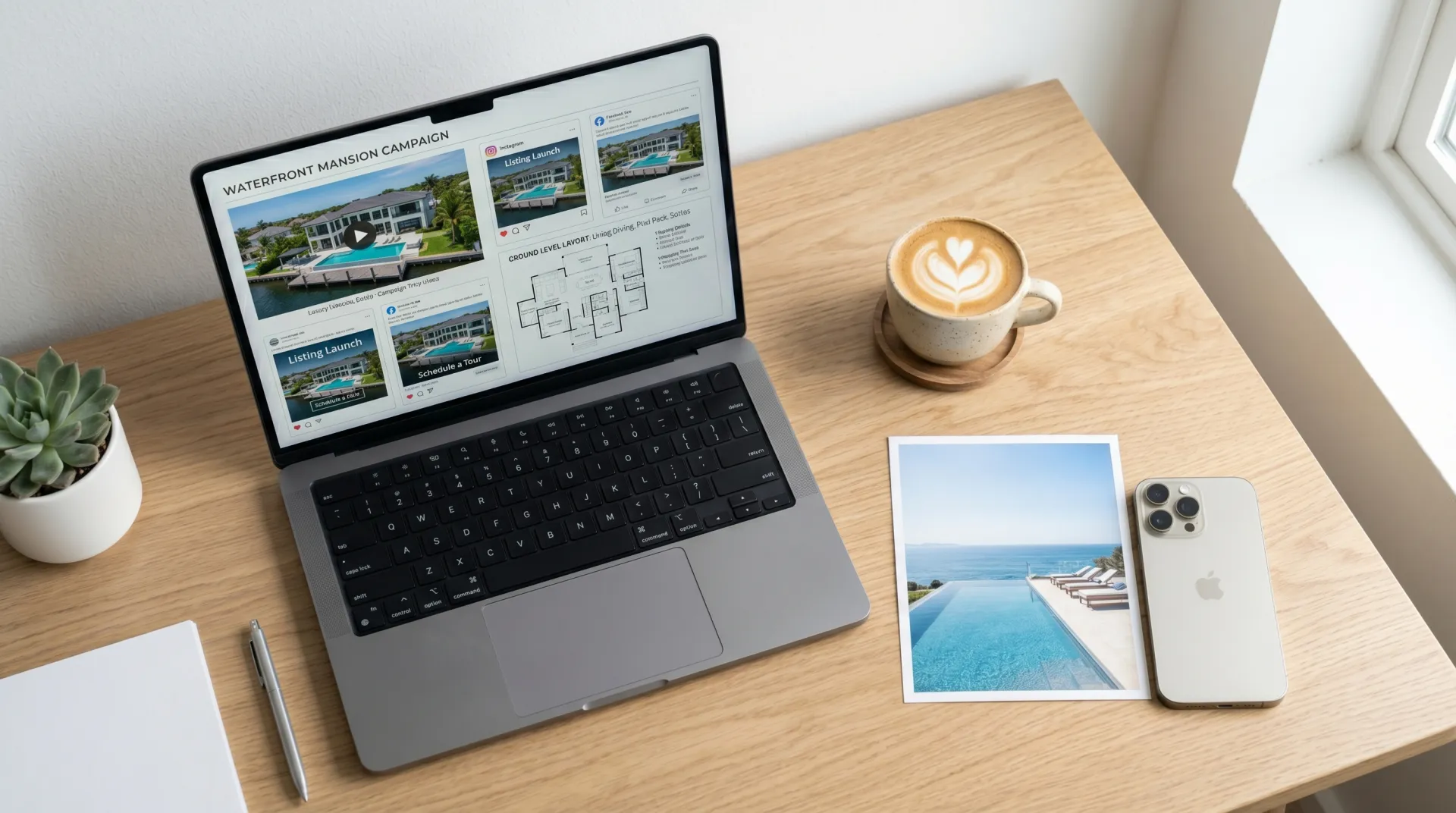
What Makes a Luxury Real Estate Marketing Campaign Win
What makes a successful luxury real estate marketing campaign? More often than not, it comes down to whether the marketing matches the property's actual calibre, or treats it like a standard listing with an extra zero on the price. A $6 million home photographed with a wide-angle lens and uploaded to a portal isn't a luxury campaign. It's a missed opportunity dressed in granite countertops. High-net-worth buyers don't browse listings the way typical buyers do. They evaluate. They qualify. Research consistently shows they conduct substantial digital research before making contact, arriving with a refined shortlist and a clear sense of which presentations communicate genuine value.
A successful luxury real estate marketing campaign is a curated, multi-channel production that earns buyer trust before a single showing is booked. A growing number of leading agencies now embed creative studios into their campaigns from the beginning, not as a finishing touch, but as a core strategic partner. Sydney-based 101 Studios approaches every listing as a narrative-driven production rather than a documentation exercise, building the kind of cohesive creative pipeline that performs across every channel a luxury buyer touches.
What follows is a practical framework covering the core components, channel strategy, budget benchmarks, KPIs, and a pre-launch checklist to help you build a high-end real estate marketing strategy that attracts serious buyers and converts them faster.
Why luxury property marketing demands a campaign mindset
Ninety-two percent of high-net-worth buyers begin their property search online. They expect visual sophistication and narrative clarity long before they commit to a viewing. By the time they make contact, they've already filtered out listings that didn't communicate value at first glance. The campaign does the qualifying work, not the showing.
A standard listing push involves uploading photos, setting a price, and waiting for portal traffic. A true prestige real estate marketing campaign is different in every dimension: it begins weeks before launch, coordinates cinematic creative assets across multiple channels, runs targeted paid media to reach affluent demographics by income and lifestyle interest, and uses retargeting to stay visible during the extended decision cycles that luxury buyers operate on. A campaign creates demand. A listing simply responds to whatever demand already exists.
The business case for investing at this level is supported by available industry data. Comprehensive digital strategies have been associated with significantly faster sales compared to traditional methods, some estimates citing up to 27% reductions in time on market. Influencer-integrated campaigns have also shown stronger qualified inquiry rates than conventional approaches. The Itz'ana Resort case is a concrete illustration: 80% of villas sold before the property's soft opening at a 15 to 20% price premium over regional competitors, the result of coordinated campaign thinking executed with discipline from day one. For practical guidance on proven tactics tailored to attract affluent buyers, see proven strategies to attract high-end buyers.
What makes a successful luxury real estate marketing campaign: the creative assets
Cinematic video is the anchor asset for any serious luxury real estate promotion. It isn't just the highest-engagement format, it drives qualified lead conversion by giving buyers an emotional connection to a property they may never have physically visited. The Drumelia campaign for Villa Cullinan is the clearest documented example: a three-part video series comprising a teaser, an architecture film, and a full property tour generated over 5.5 million YouTube views and sold the €32 million property to a buyer who had never set foot in Spain. Short-form reels on Instagram and YouTube Shorts extend that reach to affluent millennial and Gen X demographics, where research suggests both groups are active and reachable through paid social targeting.
Editorial photography remains foundational. High-resolution, mood-driven images shot with a fashion-inspired eye are the first impression a buyer forms before engaging with video or touring content, and they meaningfully accelerate sale speed compared to standard listing photography. Drone aerials add a dimension that ground-level work physically can't: they communicate scale, neighbourhood prestige, and contextual value in a single frame. For remote and international buyers, 3D virtual tours (Matterport-style experiences) rank among the most effective luxury campaign assets, enabling buyers to explore a property at their own pace and build genuine purchase confidence before committing to a flight or a showing. For deeper tactical approaches across luxury campaigns, review the 12 key strategies for luxury property marketing success.
What separates a studio like 101 Studios from a photographer-for-hire arrangement is the end-to-end creative pipeline. Strategy, cinematic production, colour grading, short-form social edits, and 3D tour delivery arrive as a cohesive visual identity, not a folder of disconnected files. That coherence is what performs across every channel a luxury buyer touches, from the listing portal to Instagram to a private email from their agent. When every asset carries the same narrative thread, buyers develop a sense of the property before they ever visit it.
The channels that actually reach high-net-worth buyers
Seventy-eight percent of high-net-worth buyers use multiple digital platforms during their property search. Concentrating your campaign on a single channel, even a strong one, leaves meaningful segments of your target audience unreached. The core digital stack for a luxury home advertising strategy includes SEO-optimised listing pages, Google PPC, and YouTube, where full-length video tours rank well in search and serve remote buyers effectively, alongside remarketing to maintain visibility during the extended decision cycles that are normal at the luxury tier.
Paid social is where affluent targeting becomes precise. Instagram and Facebook offer income-based and interest-based audience parameters that allow campaigns to reach qualified demographics directly, though exact targeting capabilities vary by region and platform policy, so confirm current options with your media buyer. Facebook retargeting with 3D virtual tour content achieved an 11% click-through rate in one campaign cited across multiple real estate marketing case study roundups, placing it well above the industry average of 0.99%. That kind of performance reflects what happens when immersive content meets accurate audience targeting. Short-form Reels and influencer partnerships amplify reach further, introducing properties to high-net-worth networks that paid media alone doesn't fully penetrate. For examples of successful influencer-led tactics in the luxury segment, see influencer partnerships that win premium listings.
Digital channels dominate, but PR and print placements in prestige publications, the Wall Street Journal, Forbes, and luxury lifestyle titles, add a layer of credibility that reinforces campaign authority. These placements reach buyers who remain sceptical of agencies without a print or broadcast footprint. Private preview events, curated open-home experiences, and selective pop-up activations build the offline credibility that closes buyers who've been watching from a distance. The most effective campaigns run all three layers simultaneously: digital reach, social targeting, and premium offline presence.
How to structure your luxury campaign budget
Luxury-tier marketing investment typically runs 7 to 12% of gross commission income, with higher-growth operations pushing toward the upper range. Within that total, the split across campaign components follows a broadly consistent logic based on synthesised industry benchmarks: production and creative (15 to 30%), digital paid media (25 to 40%), PR, events, and print (10 to 20%), and listing syndication platforms (15 to 30%). These are estimates derived from available data rather than fixed industry standards, treat them as a starting framework and calibrate to your specific market and property profile. For more on marketing budget guidance for real estate professionals, consult this practical overview of real estate marketing budget benchmarks.
The 70/20/10 framework is a useful allocation tool for premium property marketing campaigns. Seventy percent goes to proven performers: digital advertising and premium listing syndication on platforms that reach affluent buyers directly. Twenty percent supports relationship-building channels: PR, curated events, and influencer partnerships that build credibility over time. Ten percent goes to experimental tactics, emerging platforms, interactive tools, or new content formats. The critical discipline is reviewing these allocations quarterly based on cost-per-qualified-lead data, not habit or gut instinct.
The KPIs top brokers track to know if it's working
Volume metrics are largely vanity in luxury real estate. Raw portal view counts or total inquiry numbers tell you almost nothing about campaign health. The metrics that signal whether a high-end real estate marketing effort is working are more specific. Time-to-first-value (TTFV) measures how long it takes from initial buyer contact to delivering a tangible value item, a pricing narrative, a comparable sales brief, or an off-market strategy map. Luxury buyers prioritise certainty and trust, and reducing TTFV creates a direct competitive advantage. One luxury producer improved their consult-to-agreement conversion by 18% in a single quarter by tightening their first-value deliverable into a consistent 48-hour rhythm.
Referral conversion rate tracks what percentage of referrals received actually convert to signed agreements. This matters because referral sources are lending you their reputation, any inconsistency in your process gives them reason to stop sending prospects. Beyond these two, track appointment-to-listing conversion rate, qualified showing counts, and overall lead conversion rate. The industry benchmark sits at 4.7%, with organic search converting at 3.2%. Channel-level cost-per-qualified-lead data ties everything together, showing exactly which media spend is generating genuine buyer intent versus impressions that never move toward a sale.
A pre-launch checklist for your next luxury campaign
Before the campaign goes live
Lock in the strategic foundations before the camera rolls. Define the target buyer persona clearly: age range, geography, lifestyle, what they value beyond square footage. Establish the price narrative and the comparable sales context. Brief your creative team on the campaign mood, the story the property should tell, and the emotional experience a buyer should feel after watching the hero video. Confirm staging is complete before the shoot is scheduled. For why scheduling and the timing of photography and video shoots matter to the final result, read about timing of photography and video shoots.
Set up tracking pixels and dedicated landing pages before any media goes live. Launching without measurement infrastructure is the single most common and costly oversight in luxury campaign execution, and it's entirely avoidable.
During the active campaign
Review paid social cost-per-lead and click-through rates weekly. Monitor video view-through rates to confirm the creative is holding attention, not just generating impressions. Track inquiry quality, not just volume, and watch remarketing audience growth as a proxy for sustained interest.
Respond to new leads within hours where possible. Research on luxury buyer behaviour indicates that prompt response times, measured in hours rather than days, meaningfully improve conversion outcomes. High-net-worth buyers who don't hear back move quickly to the next agent who makes them feel attended to.
After the campaign closes
Run the audit that most agents skip. Measure time on market against comparable listings, total qualified showings generated, cost-per-qualified-lead by channel, referral conversions triggered by the campaign, and total production ROI. This review doesn't just tell you what worked. It builds the brief for the next campaign and gives you concrete evidence to bring into future vendor conversations. Agents who treat the post-campaign review as a strategic asset consistently outperform those who treat it as an administrative formality.
Build campaigns that match the quality of the properties you represent
What makes a successful luxury real estate marketing campaign isn't a checklist of tactics assembled at the last minute. It's a coherent creative and media strategy built around how high-net-worth buyers actually make decisions, visually, digitally, and emotionally, across timelines that extend well beyond a standard sales cycle. The agents and brokers who consistently win at this level treat every campaign as a production. They invest in cinematic visuals, target affluent buyers across coordinated digital channels, allocate budget with data, and track the metrics that reflect genuine buyer intent.
Whether you're launching your first prestige listing or refining a luxury home advertising approach that underdelivered, the framework above gives you a clear foundation. Identify the story, build assets that carry it, place those assets where qualified buyers are actually looking, and measure what moves the needle. The properties you represent deserve marketing built to match them.
If the visual production side is where your current campaigns fall short, that's precisely where the right production partner determines whether a listing becomes a campaign. 101 Studios brings the full pipeline, campaign strategy, cinematic shoots, colour grading, and social-ready edits, so every asset works together from the first frame to the final close.
Ready to execute a cinematic campaign?
101 Studios builds every shoot around a clear strategic objective, delivering unmatched visual impact across Sydney and Australia.
Book 101 Studios